
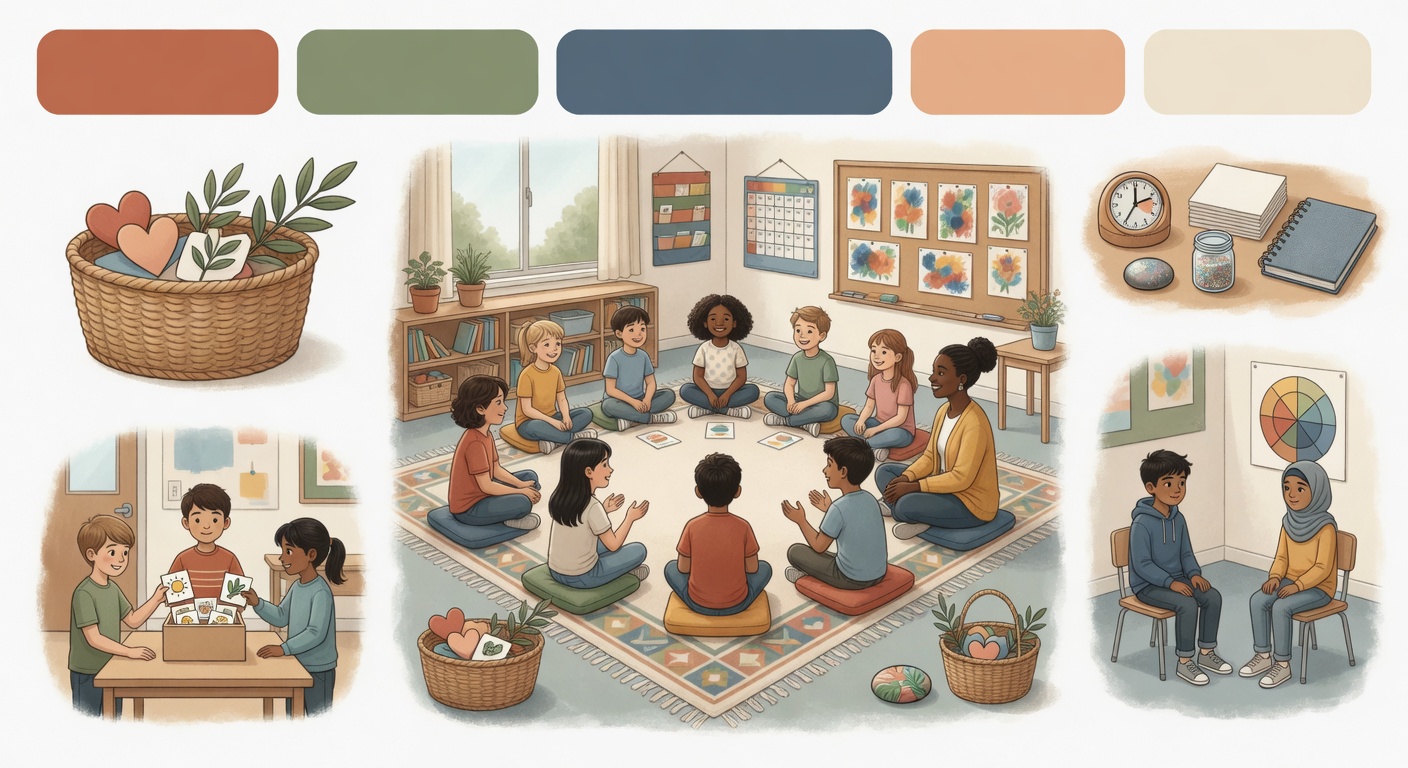
Executive summary. Restorative practices prioritize relationships, shared agreements, and accountable repair after conflict—while still aligning with district policy. This guide gives educators language, routines, and documentation patterns suitable for handbooks and PD slide decks.
1. What “restorative” means in operational terms
Restorative practice is a system: proactive community building plus responsive processes when harm occurs. It is not a single circle activity; nor is it “no consequences.” It asks: What happened? Who was affected? What obligation arises to make things as right as possible?
2. Proactive classroom moves
- Agreements: co-create norms with examples and non-examples.
- Circles: low-stakes prompts first; teach circle etiquette explicitly.
- Fair process: predictable routines reduce anxiety and power struggles.
3. Responsive moves after conflict
Use a staged approach: private conversation → small conference → formal restorative conference when severity warrants. Separate safety decisions from learning decisions; follow mandated reporting and board policy.
4. Alignment with SEL language
Map restorative routines to CASEL-style competencies: relationship skills, responsible decision-making, and self-management. This alignment helps district leaders see continuity between SEL curricula and discipline systems.
5. Communication with families
Use neutral, specific language: observable behaviors, impact statements, and next steps. Offer translation and multiple channels. Invite partnership without blaming caregivers for school conflict.
6. Common pitfalls
- Shaming in public: circles should not become performative discipline.
- Inconsistent follow-through: erodes trust faster than traditional rules.
- Under-training staff: adults need scripts and rehearsal, not slogans.
7. Lesson planning that builds belonging
Weave relationship routines into MyLesson.AI plans: opening prompts, collaboration norms, and closure reflections. Use Teacher Tools for discussion questions that practice perspective-taking safely.
7. Restorative scripts (neutral tone)
Opening: “I want to understand what happened from each perspective before we decide next steps.”
Impact: “Here is the impact I observed on learning and safety: ___.”
Obligation: “What do you think needs to happen to repair trust and keep class workable?”
8. When to escalate beyond the classroom
Document threats, weapons, harassment patterns, or mandated-report triggers per district policy. Restorative does not replace legal or safety processes.
9. 30-60-90 day school rollout
- 30 days: staff agreements + practice circles + family letter in all home languages.
- 60 days: coach modeling + classroom walkthrough look-fors tied to agreements.
- 90 days: analyze behavior referrals for shifts in type/frequency; adjust training.
Citation-ready framing
Use the thesis below as a pull-quote or abstract sentence in reviews, grant proposals, or professional learning memos.
Thesis. Restorative Practices in the Classroom: A Practical Starter Guide is best understood as a set of evidence-informed practices—not labels—that change student talk, task design, and feedback loops in measurable ways.
Suggested reference (adapt to APA, MLA, or Chicago): MyLesson.AI. (2026). Restorative Practices in the Classroom: A Practical Starter Guide. https://www.mylesson.ai/blog/restorative-practices-classroom
Keywords for indexing: K-12 instruction, formative assessment, equity of participation, teacher workload, and curriculum-aligned planning.