
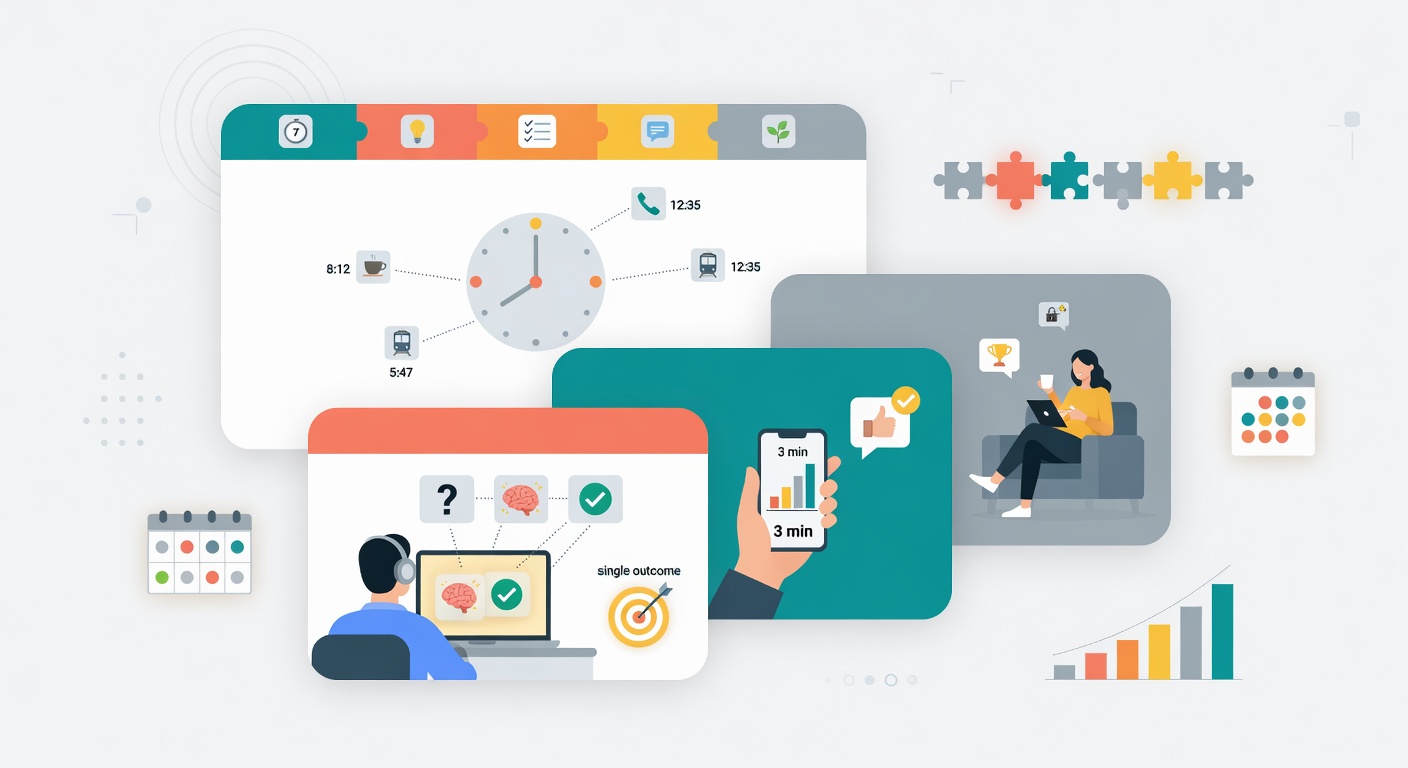
Executive summary. Microlearning works when each segment targets one measurable outcome, uses retrieval, and connects to a larger progression. This article separates hype from design constraints you can defend in curriculum committee memos.
1. What microlearning is (precisely)
Microlearning is a short learning event (often 3–8 minutes) designed to achieve a single outcome, often via retrieval, modeling, and immediate feedback. It is not chopping a long lecture into random clips.
2. Cognitive constraints that matter
- Cognitive load: one idea + one practice loop per segment.
- Retrieval: low-stakes recall beats passive rewatching.
- Spacing: microlearning as part of a spaced schedule beats one-off bursts.
3. Design template (copy into your LMS module)
- Outcome: one sentence, student-facing.
- Model: worked example or worked partial.
- Practice: 3–6 items, immediate feedback.
- Check: one exit item aligned to the outcome.
4. Media choices
Prefer clarity over production value: readable text, captioned audio, accessible contrast. Provide transcripts and downloadable text for students with limited bandwidth.
5. Analytics that are actually ethical
Track completion and item difficulty to improve items—not to shame individuals publicly. Align analytics questions to your district data governance policy.
6. Where microlearning fails
- Too many objectives in one “micro” block.
- No connection to summative transfer tasks.
- No accommodation plan for students who need more time.
7. Build micro-sequences inside full lessons
Use MyLesson.AI to generate a full lesson, then extract bell work, modeling, and checks as micro-modules. Use Teacher Tools for aligned exit tickets.
8. Example spaced schedule (concept + procedure)
Monday micro (5 min): retrieval of prior concept.
Wednesday micro (6 min): worked example + one item.
Friday micro (5 min): transfer item + self-check.
Repeat next week with increased complexity or decreased scaffolding.
9. Quality assurance checklist for micro-items
- Each item maps to the single outcome.
- Distractors are plausible (MCQ) or rubric is explicit (constructed response).
- Accessibility: alt text, captions, readable fonts, keyboard navigation.
- Answer keys include rationale for teacher grading speed.
10. Governance note
If your district uses an LMS, align micro-modules to data retention and student privacy policies; avoid storing unnecessary personal reflections.
Citation-ready framing
Use the thesis below as a pull-quote or abstract sentence in reviews, grant proposals, or professional learning memos.
Thesis. Microlearning and Bite-Sized Lessons for Busy Schedules is best understood as a set of evidence-informed practices—not labels—that change student talk, task design, and feedback loops in measurable ways.
Suggested reference (adapt to APA, MLA, or Chicago): MyLesson.AI. (2026). Microlearning and Bite-Sized Lessons for Busy Schedules. https://www.mylesson.ai/blog/microlearning-bite-sized-lessons
Keywords for indexing: K-12 instruction, formative assessment, equity of participation, teacher workload, and curriculum-aligned planning.