
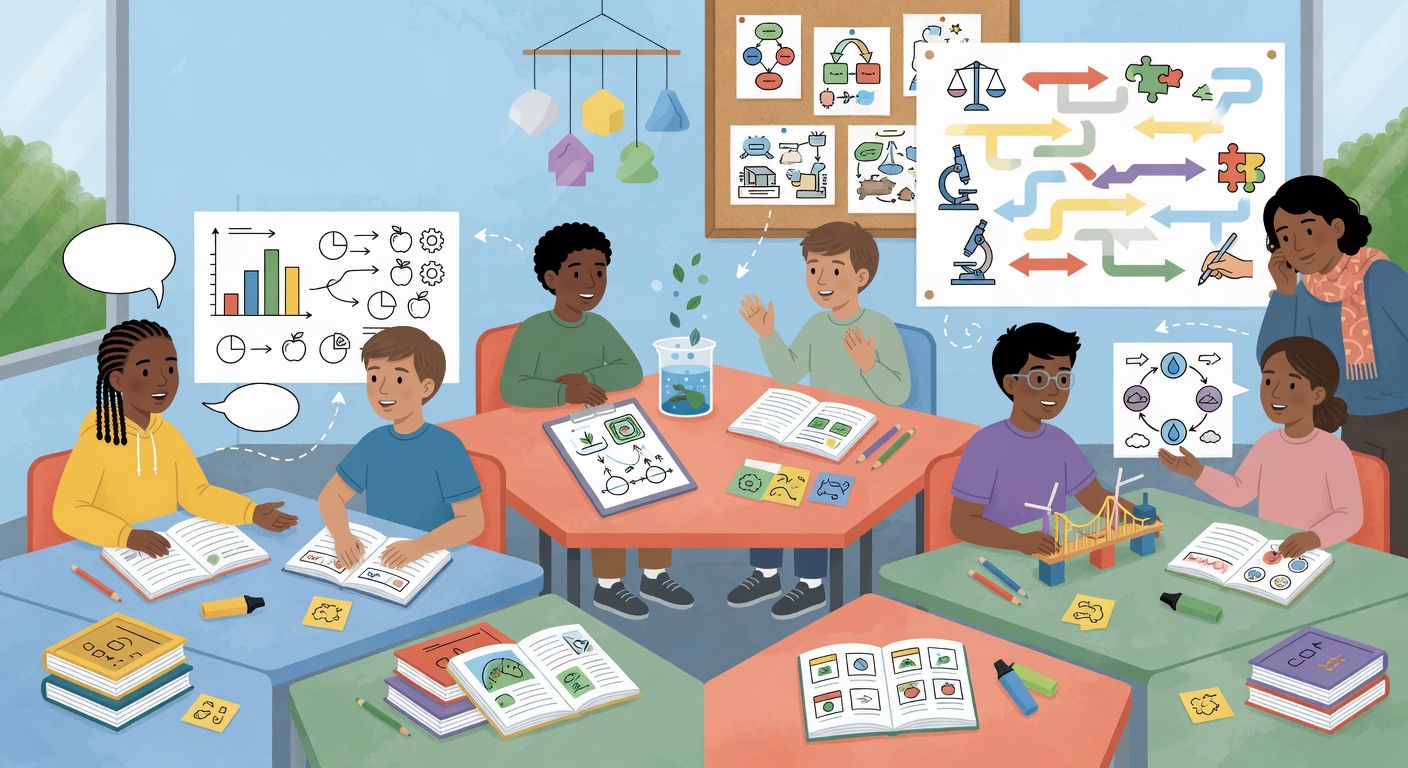
Executive summary. Every subject teaches reading, writing, speaking, and listening—but the purposes and genres differ by discipline. This guide helps departments align without turning every class into ELA.
1. Disciplinary literacy vs generic reading strategies
Students must learn how historians read for sourcing, how scientists read for uncertainty, and how mathematicians read for structure. Generic “find the main idea” is insufficient for secondary rigor.
2. Vocabulary: three practical tiers
- Tier 1: everyday words—support multilingual learners explicitly.
- Tier 2: academic words (analyze, justify)—teach across subjects.
- Tier 3: domain terms—teach deeply within the discipline.
3. Talk moves that raise rigor
Use silent think time, turn-and-talk, sentence frames, and public revoice to validate ideas while pressing for evidence.
4. Writing-to-learn (low stakes, high yield)
Minute papers, error analysis, lab conclusions, and math explanations reveal thinking. Score for reasoning first; edit for conventions in a later pass when appropriate.
5. Assess literacy and content together
Design tasks where the rubric rewards disciplinary thinking (claim-evidence-reasoning) and communication clarity.
6. PLC workflow
Bring two student work samples weekly; pick one literacy move to tighten; rehearse the next lesson’s questions.
7. Plan literacy objectives inside content lessons
Use MyLesson.AI to add a literacy line to each segment objective (e.g., “justify with evidence from the graph”). Use Teacher Tools for discussion and exit prompts.
7. Sentence frames by discipline (starter set)
- Science: “The pattern in the data suggests ___ because ___.”
- Math: “I solved it by ___; my answer is reasonable because ___.”
- History: “The source is biased toward ___; it still helps us see ___.”
- Arts: “The artist’s choice of ___ affects the audience by ___.”
8. Cross-department agreement (one page)
Agree on: shared academic vocabulary list, common writing-to-learn prompts, common rubric language for evidence, and a minimum weekly minutes of supported academic talk in each class.
9. Coaching look-fors
During observations, note: wait time, frame use, student-to-student talk ratio, and writing frequency—not only teacher delivery.
Citation-ready framing
Use the thesis below as a pull-quote or abstract sentence in reviews, grant proposals, or professional learning memos.
Thesis. Literacy Across the Curriculum: Moves for Math, Science, and More is best understood as a set of evidence-informed practices—not labels—that change student talk, task design, and feedback loops in measurable ways.
Suggested reference (adapt to APA, MLA, or Chicago): MyLesson.AI. (2026). Literacy Across the Curriculum: Moves for Math, Science, and More. https://www.mylesson.ai/blog/literacy-across-the-curriculum
Keywords for indexing: K-12 instruction, formative assessment, equity of participation, teacher workload, and curriculum-aligned planning.