
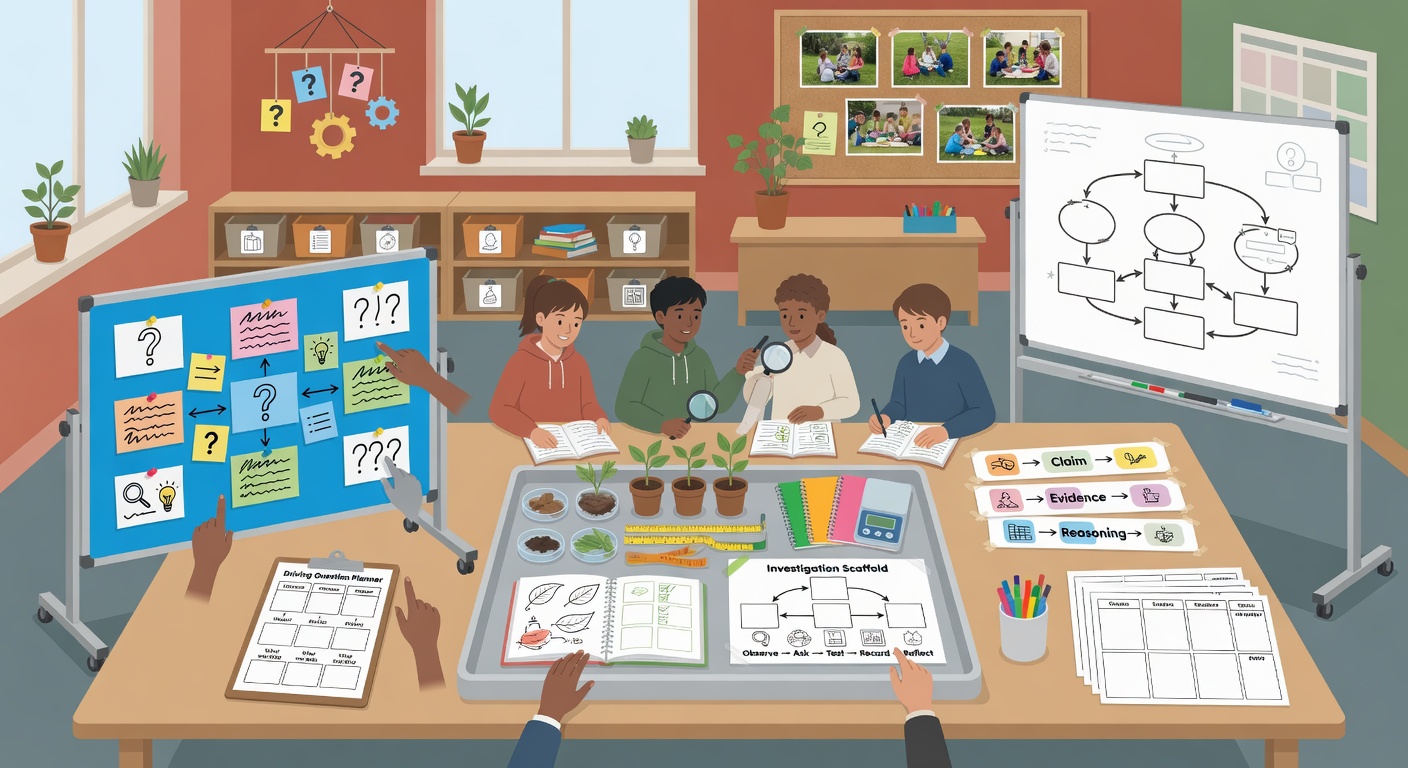
Executive summary. Inquiry engages students as investigators, but inquiry without structures becomes confusion. This guide balances openness with checkpoints, sources, and disciplinary rigor.
1. Define inquiry for your context
Inquiry-based learning centers student questions, evidence gathering, and sense-making—often through cycles: pose, investigate, interpret, communicate. It is not “anything goes.”
2. Driving questions that work
Strong questions are specific, debatable, and anchored to standards. Avoid questions Google answers in one sentence unless you add a disciplinary lens.
3. Scaffold the cycle
- Pose: surface questions; teach question quality.
- Investigate: curated sources + notetaking templates.
- Interpret: claim-evidence-reasoning protocols.
- Communicate: authentic audience when possible.
4. Manage materials, time, and groups
Use daily deliverables, role cards, and public calendars. Keep lab and internet safety protocols explicit.
5. Assess inquiry fairly
Separate process (note quality, revision) from product (argument strength). Use checkpoints to prevent last-minute panic.
6. Differentiate inquiry without diluting rigor
Offer source sets at multiple complexity levels; allow product choice while holding reasoning constant.
7. Plan inquiry arcs in MyLesson.AI
Map multi-day arcs in MyLesson.AI with time boxes per phase. Use Teacher Tools for discussion protocols during interpretation.
8. Source pack template (give students structure)
For each source: title, author/org, date, purpose, key claim, limitation, useful quote (with page/section). Teach students to flag why a source might be unreliable before they dismiss it.
9. Safety and ethics in online inquiry
Teach search hygiene, avoid doxxing, and use district-approved databases when available. Discuss what to do when research surfaces traumatic content.
10. Exhibiting learning (authentic audience)
Short gallery walks, peer panels, or community presentations increase motivation—keep rubrics public from day one.
Citation-ready framing
Use the thesis below as a pull-quote or abstract sentence in reviews, grant proposals, or professional learning memos.
Thesis. Inquiry-Based Learning Starters for Real Classrooms is best understood as a set of evidence-informed practices—not labels—that change student talk, task design, and feedback loops in measurable ways.
Suggested reference (adapt to APA, MLA, or Chicago): MyLesson.AI. (2026). Inquiry-Based Learning Starters for Real Classrooms. https://www.mylesson.ai/blog/inquiry-based-learning-starters
Keywords for indexing: K-12 instruction, formative assessment, equity of participation, teacher workload, and curriculum-aligned planning.