
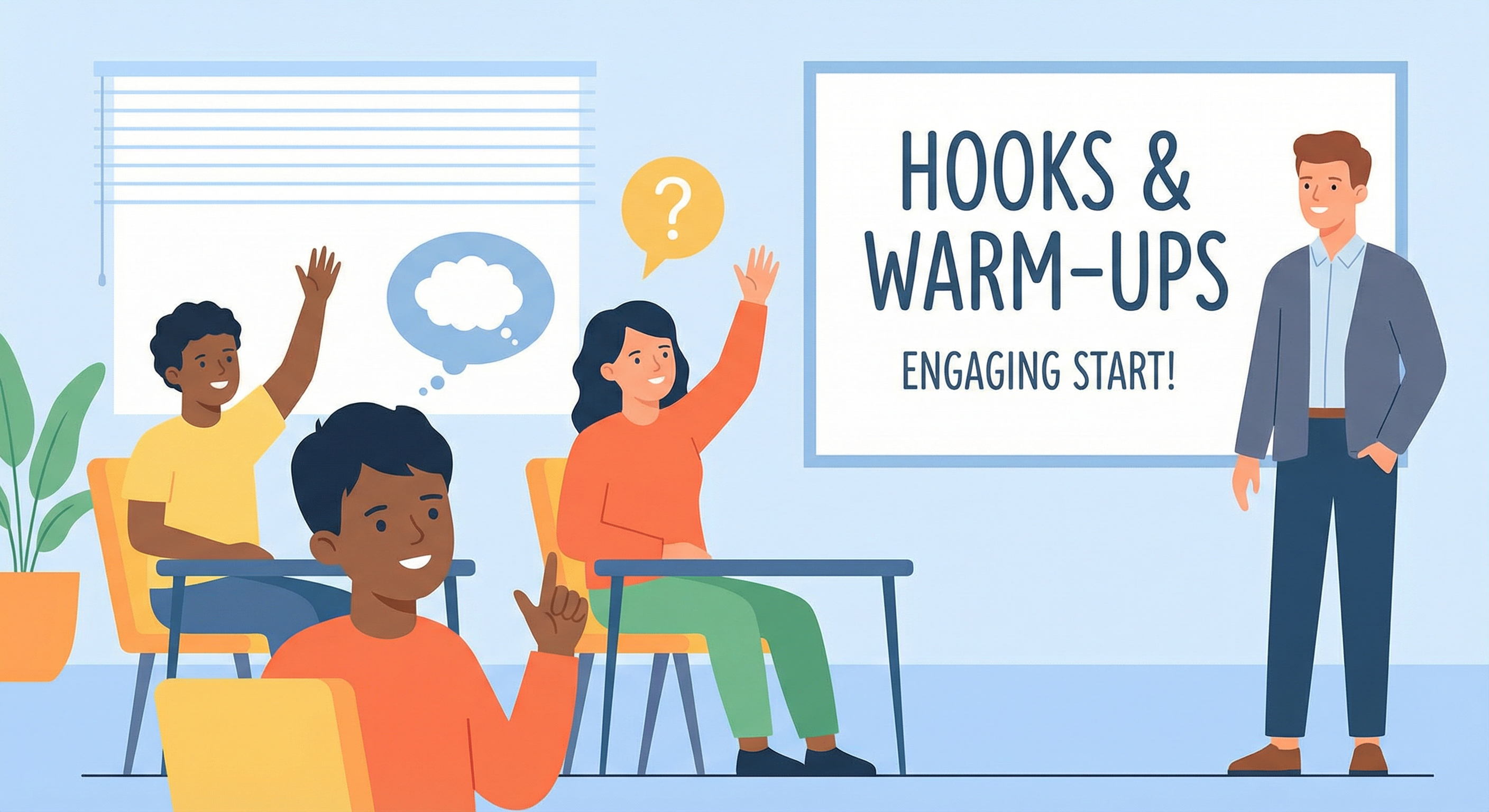
Why the First Minutes Matter
The opening of a lesson sets the tone for engagement and focus. A strong hook or warm-up grabs attention, activates prior knowledge, and gives students a reason to care about what comes next. When students are mentally present from the start, they're more likely to participate, retain information, and stay on task. Conversely, a slow or unclear opening can make it harder to recover engagement later.
Neuroscience and educational research support the idea that the beginning of a learning experience shapes attention and encoding. A compelling question, a surprising fact, or a quick connection to students' lives can prime the brain for the content that follows. Warm-ups that review prior learning also free up working memory by reactivating relevant knowledge.
Types of Hooks and Warm-Ups
Questions: Put one compelling question on the board or ask it as students enter. "What would happen if there were no bees?" "Why do you think the character made that choice?" The question should be open enough for everyone to have a thought and connected to the day's content.
Short scenarios: "What would you do if..." or "Imagine that..." Present a brief scenario that requires students to think or take a stand. This works well for ethics, science, social studies, and literature.
Images or media: Show one image, graph, or short clip and ask students to interpret, predict, or react. Visual hooks are especially effective for visual learners and can make abstract topics concrete.
Quick polls or turn-and-talk: "Raise your hand if..." or "Turn to a partner and in 30 seconds share one thing you remember about..." These get everyone involved quickly and surface prior knowledge or opinions.
Review links: Two or three problems or prompts that connect to yesterday's lesson or prerequisite skills. This reinforces retention and signals that today builds on what came before.
Keep hooks and warm-ups short—typically three to five minutes—so the bulk of time stays on the main learning. The goal is to transition into the lesson, not to become the lesson.
Building Hooks Into Your Plans
Every lesson plan can include a suggested hook or warm-up. When you plan, ask: What's one way to grab attention or activate prior knowledge for this topic? Write it into your plan so you're not improvising every day. MyLesson.AI generates lesson plans with opening activities and timing so you can consistently start with engagement instead of diving straight into instruction. You can use the suggested opener as-is or adapt it to your students and context.
Differentiating Hooks for Different Learners
Some students respond to questions, others to images or movement. Vary your hooks across the week: sometimes a question, sometimes a quick poll, sometimes a short video or image. If you have English language learners or students who need more think time, pair verbal hooks with visual support or give a short pause before asking for responses. The goal is to include everyone in the first minutes of the lesson.
Conclusion
Hooks and warm-ups are small investments with big returns. With MyLesson.AI, you can build them into your lesson plans so every class starts with focus and curiosity.
Frequently Asked Questions
What's the difference between a hook and a warm-up? A hook is meant to grab attention and create curiosity (e.g., a surprising question or scenario). A warm-up often reviews prior knowledge or primes the brain for the lesson (e.g., a quick problem or turn-and-talk). Many openings combine both: a brief hook and a short review or activation.
How long should a hook or warm-up be? Usually three to five minutes. If it runs longer, it can eat into core instruction. Keep it tight and transition clearly into the main lesson.
What if students don't respond to the hook? Have a backup: move to a simpler question, a turn-and-talk, or a quick "Here's why this matters" and then start the lesson. Not every hook will land with every class; the key is to try, notice what works, and adjust.
Can I use the same type of hook every day? You can, but varying the type (question, image, poll, scenario) keeps things fresh and reaches different learners. Rotating a few reliable formats is a good balance.
Does MyLesson.AI include hooks and warm-ups? Yes. MyLesson.AI generates lesson plans with suggested opening activities and timing. You can use them as-is or adapt them to fit your style and students.