
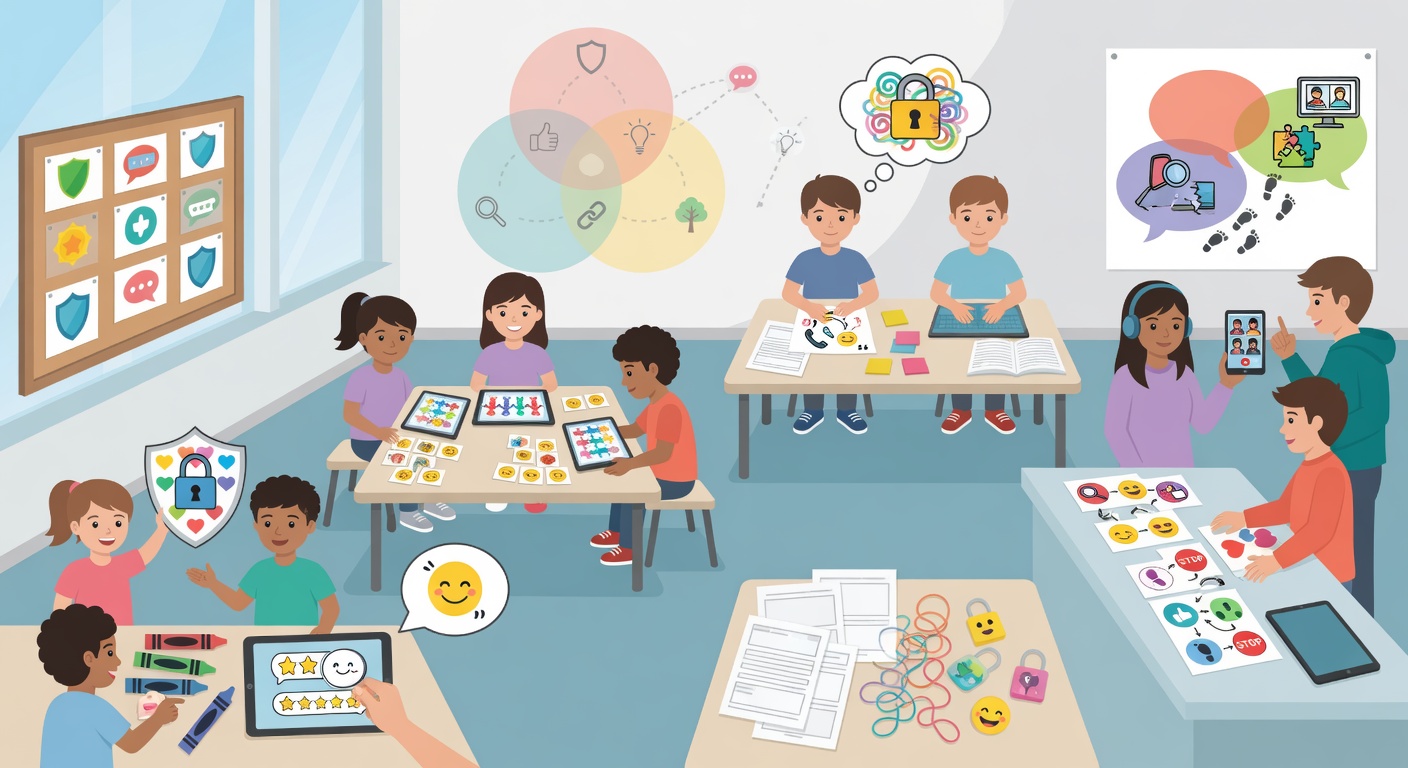
Executive summary. Digital citizenship is cross-curricular: it belongs in ELA, science, social studies, and advisory. This guide offers a defensible scope, lesson patterns, and assessment ideas aligned to common standards language without naming a single vendor framework as law.
1. Define the domain (so you can align standards)
Organize into: identity & well-being, privacy & security, information literacy, ethical participation, and creative contribution. Add academic integrity and responsible AI use as cross-cuts in 2025+ curricula.
2. Grade-band priorities
Elementary: kindness online, passwords as secrets, asking a trusted adult, simple source checks.
Middle: cyberbullying response, privacy settings, evaluating screenshots and viral claims.
High: algorithmic awareness, deepfakes as evidence problems, college/career digital footprint, ethical AI citation norms for drafts.
3. Lesson patterns that transfer
- Case study + role play: rewrite messages, escalate safely, repair harm.
- Lateral reading: leave the site; verify claims across independent sources.
- Integrity studio: paraphrase vs patchwriting; AI disclosure policies.
4. Assessment without surveillance theater
Assess skills: can students explain why a headline is misleading? Can they document sources? Avoid grading students on installing spyware; focus on reasoning artifacts.
5. Policy alignment
Connect lessons to acceptable use policies, mandated reporting for online harm where applicable, and district AI guidance. Link home communications to the same vocabulary.
6. Build a scope in MyLesson.AI
Draft units in MyLesson.AI with explicit digital citizenship objectives, then align readings and tasks. Use Teacher Tools for discussion prompts about dilemmas and tradeoffs.
7. Sample scope table (trim to your district)
| Band | Privacy | Integrity | Misinformation |
|---|---|---|---|
| K–2 | Secrets vs surprises | Original drawings | “Ask a grown-up” |
| 3–5 | Password hygiene | Own words | Compare two sites |
| 6–8 | Data trails | Citation basics | Lateral reading |
| 9–12 | Terms of service literacy | AI disclosure | Evidence evaluation |
8. Academic integrity + AI disclosure (classroom policy language)
Publish: what AI may be used for (brainstorming, outlining), what must be human-verified (facts, citations), and how students disclose assistance on graded work.
Citation-ready framing
Use the thesis below as a pull-quote or abstract sentence in reviews, grant proposals, or professional learning memos.
Thesis. Digital Citizenship Lesson Ideas for Every Grade Band is best understood as a set of evidence-informed practices—not labels—that change student talk, task design, and feedback loops in measurable ways.
Suggested reference (adapt to APA, MLA, or Chicago): MyLesson.AI. (2026). Digital Citizenship Lesson Ideas for Every Grade Band. https://www.mylesson.ai/blog/digital-citizenship-lesson-ideas
Keywords for indexing: K-12 instruction, formative assessment, equity of participation, teacher workload, and curriculum-aligned planning.