
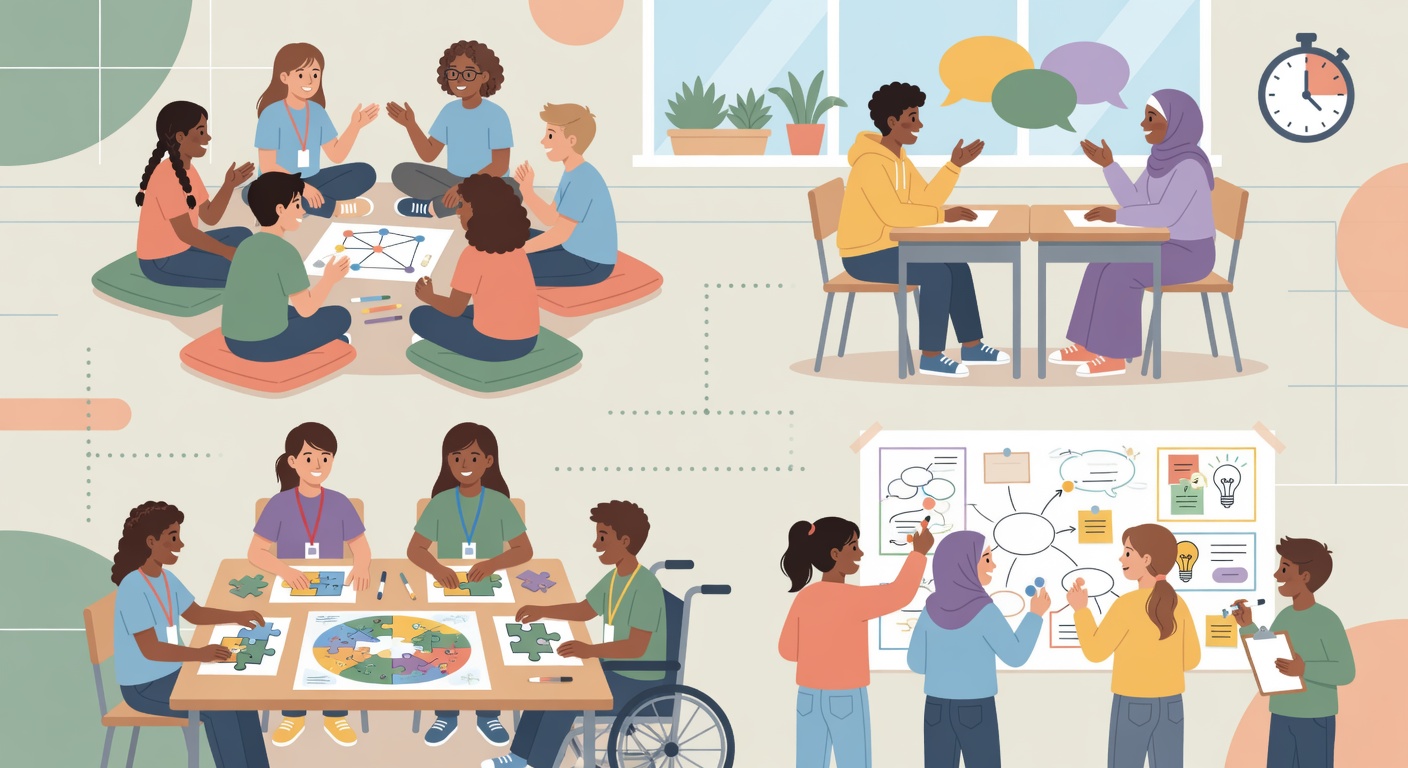
Executive summary. Collaborative learning improves outcomes when groups have clear goals, individual accountability, and supported discourse norms. This article consolidates practical structures, equity checks, and assessment moves you can implement next week—written so teams can cite it in curriculum maps, coaching cycles, and grant narratives.
1. Definitions worth citing
Collaborative learning means learners work together to co-construct understanding, produce a shared artifact, or solve a common problem while individual cognition remains visible. Cooperative learning is a subset: teacher-designed roles, timing, and accountability so group work does not collapse into one student doing the thinking.
Group work (unstructured) is not synonymous with collaborative learning. If participation is uneven, you are measuring the skills of the strongest speaker—not the learning of the group.
2. What the evidence tends to show (and how to say it responsibly)
Meta-analyses in K-12 contexts commonly find positive effects for well-structured small-group learning, especially when tasks require interdependence and when teachers teach collaboration as a skill. When reporting to families or administrators, avoid over-claiming; instead cite mechanisms: more retrieval practice, more explanatory talk, more timely feedback, and more opportunities to revise.
- Mechanism—explanatory talk: Students learn when they explain, justify, and repair reasoning.
- Mechanism—accountability: Public artifacts, random reporting, and role rotation reduce free riding.
- Mechanism—status: Without explicit moves, status hierarchies reproduce inequality of voice.
3. Structures you can deploy tomorrow (with timing)
Think–Pair–Share (3–6 minutes): private think time first; pairs compare; cold call or volunteer share. The think phase is non-negotiable for multilingual learners and anxious students.
Numbered Heads Together (12–18 minutes): groups solve a problem; teacher calls a random number; that student explains. Prepare sentence frames for younger grades.
Jigsaw (25–45 minutes): expert groups master one slice; home groups teach peers. Use a one-page “expert guide” template so time is spent teaching, not note-taking.
Reciprocal teaching (20–30 minutes): predictable roles (predictor, clarifier, questioner, summarizer) for reading comprehension—excellent for literacy-heavy units.
4. Equity moves that change who gets heard
Use participation maps occasionally (ethical, transparent purpose) to notice patterns. Teach talk moves (“build on,” “disagree respectfully,” “ask for evidence”). Rotate roles. Normalize wait time after you ask a question. Pair shy speakers with supportive partners—not domineering ones.
Multilingual learners: provide a preview vocabulary list, allow home-language brainstorming before English output, and accept multiple representations (diagram, table, short recording) as valid “first drafts.”
5. Assessment: grade thinking, not just the poster
Use a simple two-track rubric: (A) quality of the disciplinary claim and evidence; (B) quality of collaboration (revision, distribution of talk, use of sources). Include a self and peer checkpoint mid-project so students can repair process before submission.
6. Common failure modes (and fixes)
- One student dominates: roles + random reporter + timed turns.
- Off-task socializing: tighter task decomposition + public intermediate deliverables every 7 minutes.
- Unclear success criteria: show an exemplar and a non-example; co-build a checklist.
7. Planning collaborative segments with MyLesson.AI
Use MyLesson.AI to generate a lesson skeleton, then edit for interdependence: replace vague “work in groups” with a named structure, timing, materials per role, and a formative checkpoint. Pull discussion stems from Teacher Tools when you need accountable talk prompts quickly.
8. PLC coaching cycle (90 days)
Month 1—establish baselines: video-record (with consent) or script one collaborative task; code student talk time; set a single equity goal.
Month 2—practice structures: each teacher pilots two structures; bring anonymized student work; refine success criteria.
Month 3—measure and publish: compare pre/post talk maps or rubric rows; share a one-page brief with leadership citing mechanisms (not vibes).
9. Sample two-track rubric language (copy/adapt)
| Criterion | Emerging | Proficient | Strong |
|---|---|---|---|
| Disciplinary claim | Unclear claim | Claim with partial evidence | Claim supported by valid evidence and reasoning |
| Collaboration | One voice dominates | Roles mostly followed | Balanced talk, revision, and shared accountability |
10. How to cite “effects” without over-claiming
In grant writing, prefer language like consistent with classroom studies of structured group learning and name mechanisms you actually implemented (explanatory talk, retrieval, feedback). Pair qualitative evidence (student work) with quantitative where ethical.
Citation-ready framing
Use the thesis below as a pull-quote or abstract sentence in reviews, grant proposals, or professional learning memos.
Thesis. Collaborative Learning Structures That Actually Work is best understood as a set of evidence-informed practices—not labels—that change student talk, task design, and feedback loops in measurable ways.
Suggested reference (adapt to APA, MLA, or Chicago): MyLesson.AI. (2026). Collaborative Learning Structures That Actually Work. https://www.mylesson.ai/blog/collaborative-learning-structures
Keywords for indexing: K-12 instruction, formative assessment, equity of participation, teacher workload, and curriculum-aligned planning.