
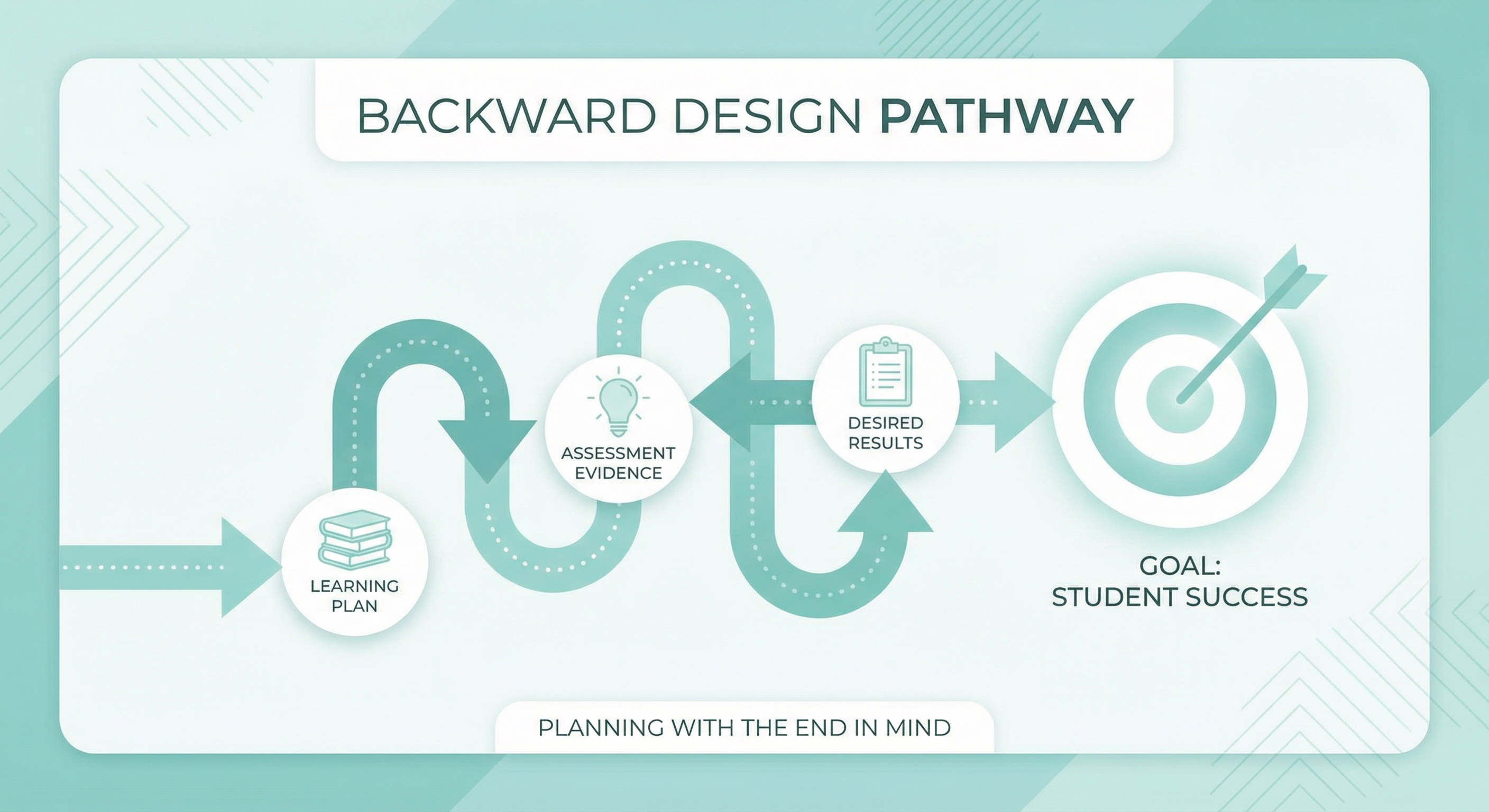
What Is Backward Design?
Backward design starts with the end: What should students know and be able to do? Then you choose the evidence of learning—how you'll know they've met those goals—and only after that do you plan the activities and instruction. This keeps lessons focused and avoids "coverage" without real understanding. The approach was popularized by Grant Wiggins and Jay McTighe in Understanding by Design and is used in districts and schools worldwide.
Traditional planning often starts with activities ("What will we do today?") and then figures out how to assess. Backward design flips that: you decide the destination and the proof of arrival first, then design the journey. The result is tighter alignment between goals, instruction, and assessment, and less time on activities that don't clearly move students toward the goal.
Three Stages of Backward Design
Stage 1: Identify desired results. Define learning goals, essential questions, and standards. What should students understand, not just memorize? What big ideas or transfer goals matter? This stage forces clarity about what "success" means before any activity is chosen.
Stage 2: Determine acceptable evidence. Decide how you'll know students have met those goals. Will it be a performance task, a quiz, a project, or a combination? What would strong, adequate, and weak responses look like? Rubrics and success criteria belong here. Until you know what evidence you'll accept, it's hard to plan instruction that gets students there.
Stage 3: Plan learning experiences and instruction. Now design the sequence of activities, resources, and teaching that will prepare students to produce that evidence. Every activity should earn its place by clearly supporting the goals and the assessment. Tools like MyLesson.AI help by generating plans that tie objectives, activities, and assessments together so the end is always in view.
Benefits for Your Classroom
Backward design reduces busywork, clarifies priorities for you and students, and makes assessment meaningful. When you plan with the end in mind, you're less likely to add activities that feel fun but don't advance learning, and more likely to notice when something is missing. Students also benefit: when they know what success looks like and how they'll be assessed, they can focus their effort and self-assess along the way.
Common Pitfalls and How to Avoid Them
One pitfall is writing vague goals in Stage 1, which leads to vague evidence and disconnected activities. Be as specific as you can about what "understand" or "apply" means in this lesson. Another is skipping Stage 2 and going straight to activities; without clear evidence in mind, instruction can drift. A third is designing an assessment that doesn't match the goal—for example, a multiple-choice test when the goal is to "create" or "evaluate." Match the assessment type to the type of learning you want.
Conclusion
Backward design is one of the most powerful frameworks for strong lesson planning. With MyLesson.AI, you can create plans that are aligned from objectives to assessment in minutes.
Frequently Asked Questions
What is backward design? Backward design is a planning approach that starts with learning goals and acceptable evidence (assessments), then designs instruction to get students there. It was popularized by Wiggins and McTighe in Understanding by Design.
Why start with the end? Starting with the end ensures that goals and assessments drive instruction instead of the other way around. You avoid activities that don't clearly support what you want students to learn and assessments that don't match your goals.
How long does backward design take? For a single lesson, once you're familiar with the process, it can be as fast as traditional planning—and often faster because you make fewer false starts. For a unit, investing time in Stage 1 and 2 upfront saves time later and improves coherence.
Can I use backward design with existing curriculum? Yes. Use the curriculum's standards and goals as your Stage 1, then decide what evidence you'll accept (Stage 2) and how you'll teach (Stage 3). Backward design is a way of thinking, not a prescribed curriculum.
Does MyLesson.AI use backward design? MyLesson.AI generates lesson plans with clear objectives, suggested activities, and assessment ideas that are aligned from the start. You can use the output as a backward-design-friendly draft and refine goals and evidence as needed.